
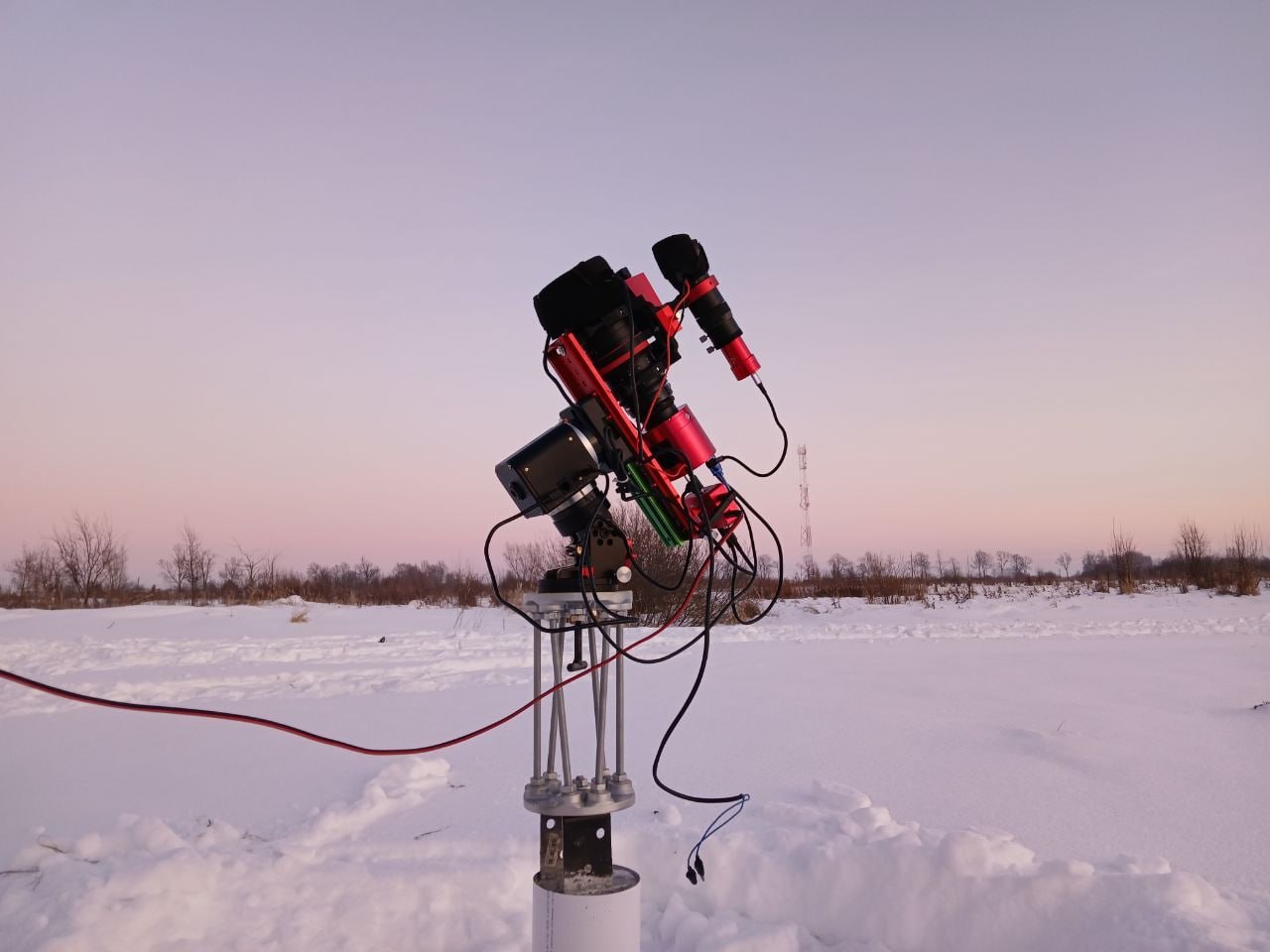
Members of the Astronomical Community of the IKBFU took advantage of the good weather for filming in mid-January 2026. The sky remained clear and free of clouds for several consecutive nights. The good weather occurred after the new moon, and the crescent moon did not interfere with observing faint celestial objects.
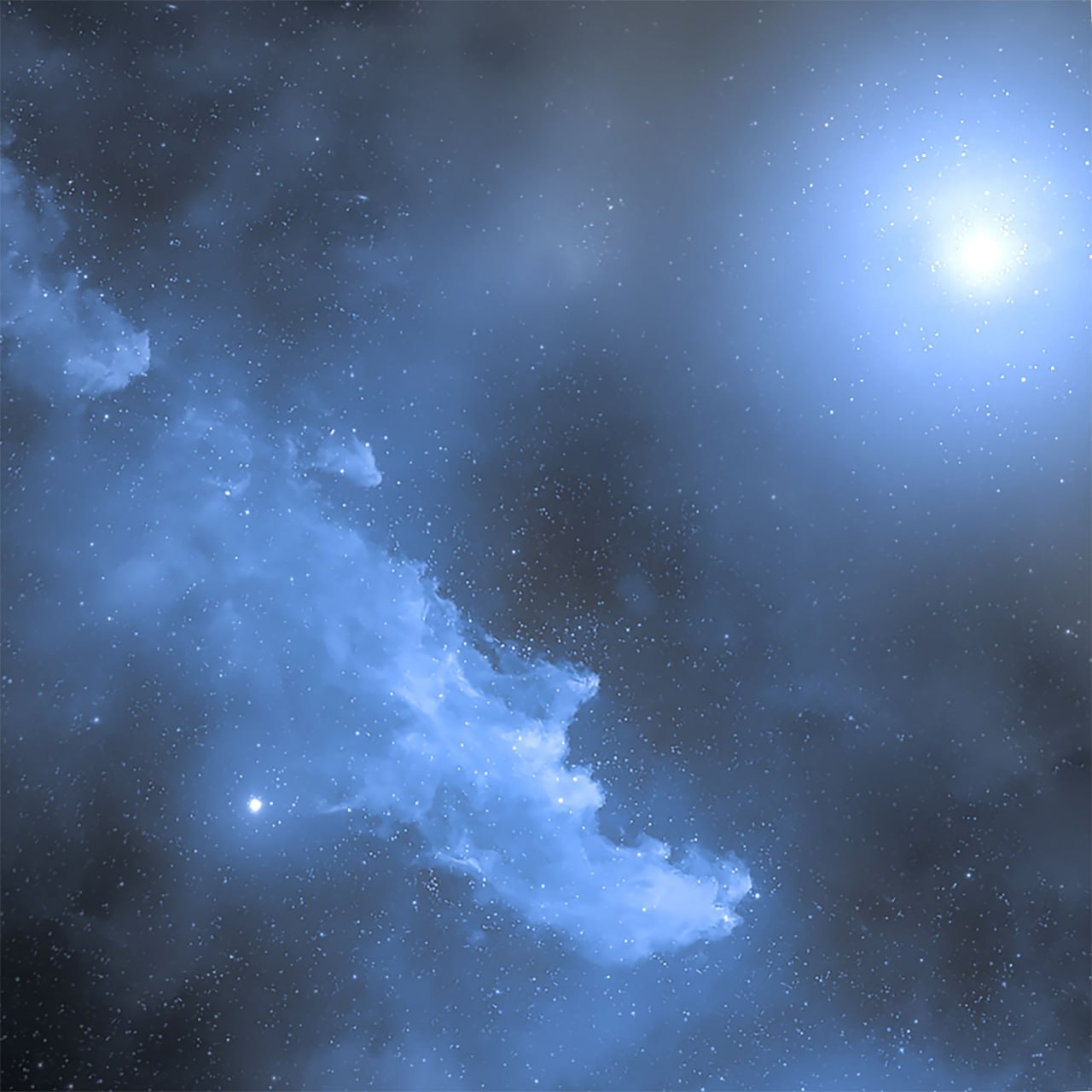
Astronomers have been filming the bluish nebula Witch's Head (IC 2118) for over 8 hours. This vast cloud of interstellar gas is located in the constellation Eridanus, near one of the brightest stars in the Northern Hemisphere, Rigel. The star's light reflects off the gas clouds in the nebula, providing it with a beautiful bluish glow. The streams of charged particles and radiation from the powerful Rigel (a star that is a hundred thousand times brighter than the Sun!) blow away the gas clouds in the nebula, giving it a bizarre, curved shape. The nebula's mass is about 85 times the mass of the Sun, and right now it is actively undergoing star formation processes — scientists have counted 15 protostars visible in the infrared range.
| Alexey Baigashov, Head of the Astronomical Society at IKBFU: |
| A combined image was created from hundreds of frames with a five-minute exposure time, each of which was colored to resemble natural colors. |
The images were captured using a robotic camera system that includes a Juwei-14 mount, a ZWO533MM Pro astrophotography camera, a ZWO220MM Mini guide camera, a Samyang 135mm f2.2 lens, a UHC filter, and a ZWO EAF focusing motor.
Another interesting object captured by the Astronomical Community of the IKBFU was the Triplet of Leo, a group of several galaxies in the constellation Leo located approximately 35 million light-years away. This group is notable for its inclusion of three spiral galaxies: M65, M66, and NGC 3628. Only the first two galaxies exhibit a characteristic spiral structure, while NGC 3628 is facing us at an angle. In terms of size, all three galaxies are comparable to the Milky Way: M66 is slightly smaller (approximately 85,000 light-years), M65 is approximately the same size (110,000 light-years), and NGC 3628 is slightly larger (150,000 light-years).
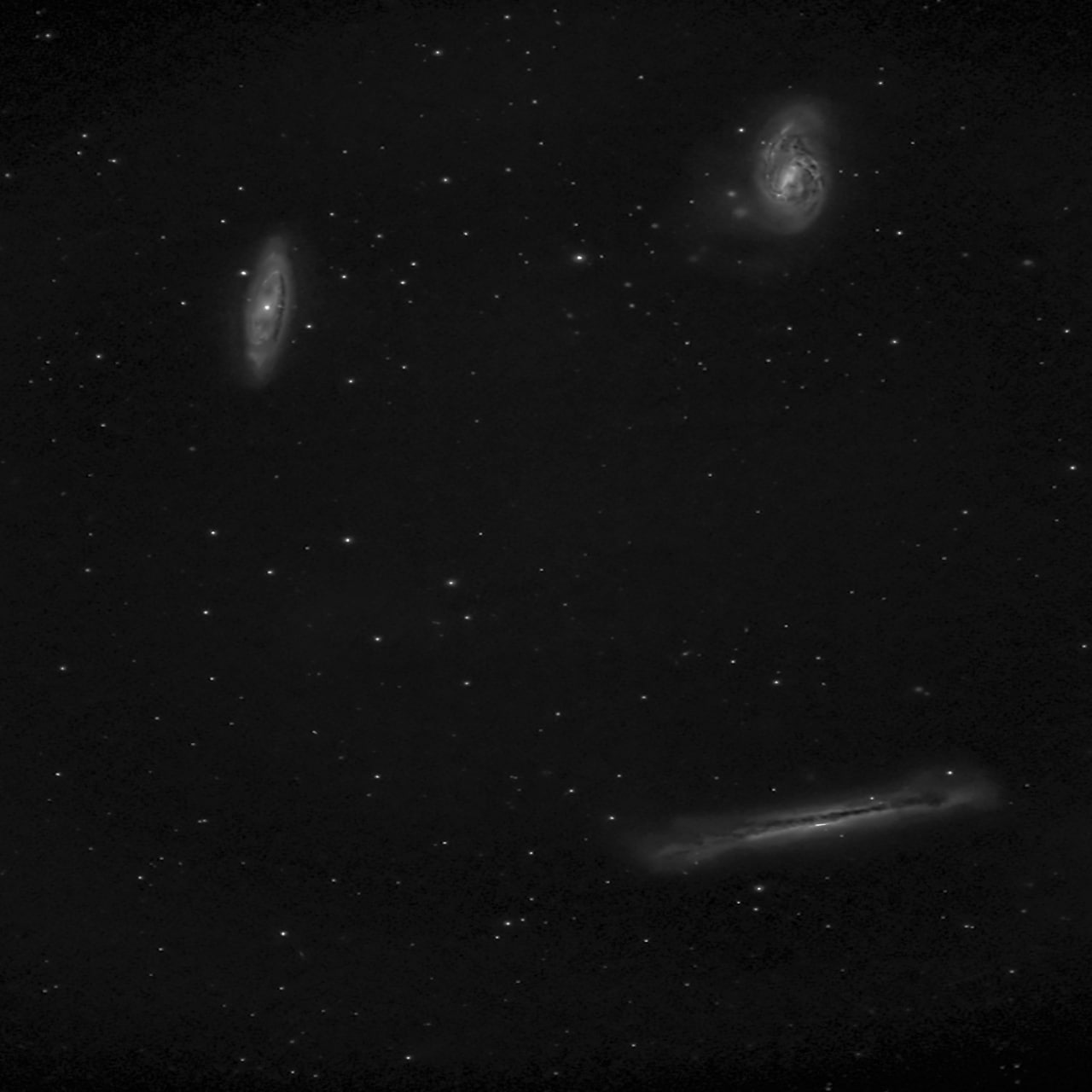
The relatively short distance of 35 million light-years separating our Galaxy from the Triplet of Leo is already enough to notice the expansion of the universe, as all three galaxies are moving away from Earth at a speed of about 800 km/s.
| Alexey Baigashov: |
| This means that this crooked "cosmic smiley face" is moving away from us at a hundred times the speed of rockets that launch satellites into Earth's orbit! |
Another interesting object in the Solar System, the short-period comet 24P/Chomassat, has been captured by astrophotographers. Unlike their long-period "sisters," which leave the vicinity of the Sun for centuries and millennia, short-period comets, as their name suggests, return to our star relatively frequently. Comet 24P/Chomassat completes a full orbit around the Sun in just eight years, traveling along an elongated orbit with a perihelion between the orbits of Earth and Mars and an aphelion beyond the orbit of Jupiter. Due to its elongated orbit, the comet does not approach the Sun too quickly, resulting in a slow loss of mass. As a result, it does not develop a spectacular gas and dust tail, and its comet nucleus remains relatively faint even at perihelion. For example, in January, the comet passed within a mere 88 million kilometers of Earth, but its apparent magnitude did not exceed 8 m. This means that it emitted only a fifth of the light emitted by the faintest star visible to the naked eye. The Astronomical Community of the IKBFU’s updated astrophotography equipment allowed us to capture even this faint comet. The animation, composed of 130 frames with two-minute exposures each, clearly shows a bright dot in the center of the screen, moving against the backdrop of distant stars.
We would like to thank the Astronomical Society of the Immanuel Kant Baltic Federal University for their information and unique photographic materials.
User profile for student
User profile for student
I give consent to the processing of the personal data provided, with Personal Data Processing Policy acquainted
Confirm consent