
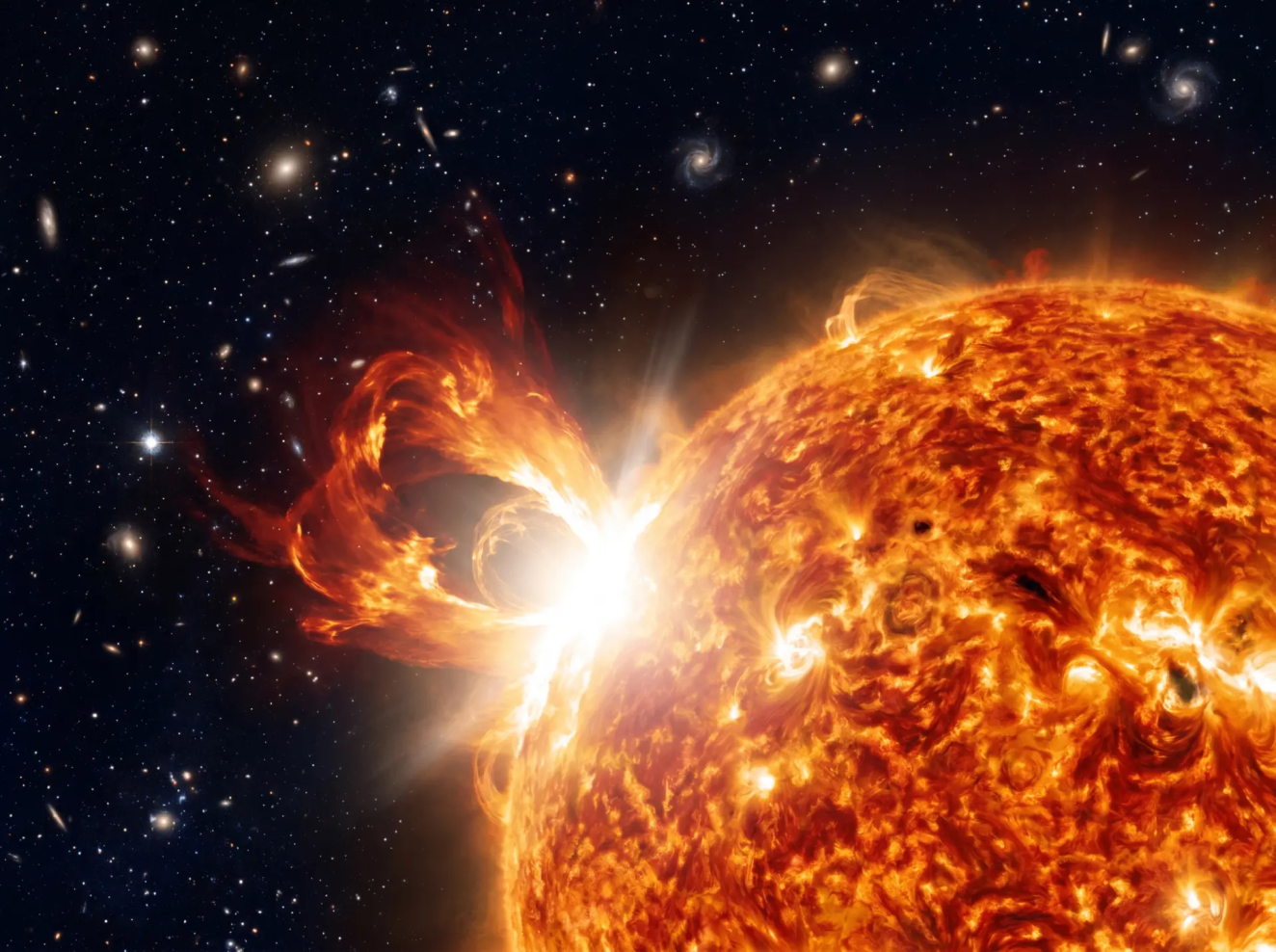
Three university satellites will go into space in 2027 to search for solar flares. Two MSU and one BFU spacecraft will observe solar gamma-ray bursts. Universities have chosen the format of small (ultra—small) artificial Earth satellites — cubesats with gamma detectors (CubeSats). The dimensions of the baby satellite are 10 × 10 × 30 cm, weight is not more than 4 kg.
The group is being created within the framework of the federal project "Personnel for Space". The operation of three devices allows you to determine the source of signal using triangulation method, as well as its coordinates, and will help clarify the nature of the flashes. Satellites will investigate gamma-ray bursts, transient gamma-ray phenomena and solar flares.
| СSergey Petrov, Head of the Laboratory of Scientific and Technical Creativity of Students and Schoolchildren of the IKBFU: |
| The essence of the project is to launch three satellites simultaneously, which we will evenly distribute around the Earth's orbit in order to detect the direction of solar radiation. A flash is a short physical phenomenon — from a few minutes to several hours. It is difficult for one satellite to accurately determine the coordinates of the flash in such a short time period, and scanning from three points will help to do this. |
The MSU and IKBFU project is an educational one, involving both students and schoolchildren interested in astronomy. The students will help scientists process signals received from satellites.

User profile for student
User profile for student
I give consent to the processing of the personal data provided, with Personal Data Processing Policy acquainted
Confirm consent