Researchers at Immanuel Kant Baltic Federal University — together with their colleagues — have successfully tested a new bioactive material for orthopaedics based on the natural mineral hydroxyapatite with the addition of nitric oxide. In the future, this development may significantly reduce the risk of prosthesis rejection and protect patients from bacterial infection. The results of this extensive inter‑university study — supported by the state project "Nauka" — have been published in the journal Applied Surface Science.
Over three million large joint replacement surgeries are performed annually — 29 per cent of which, however, result in repeated surgical interventions, during which the installed implant must be replaced. This is because traditional titanium alloy implants, while offering excellent strength, are not sufficiently bioactive — meaning they are unable to establish effective integration with living bone tissue. As a result, the prosthesis may fail to bond properly with the bone or may become a surface for bacterial growth.
To address this issue, titanium implants are often coated with hydroxyapatite — a calcium phosphate mineral similar in composition to bone tissue — which helps the prosthesis integrate with the body. Furthermore, to enhance these coatings with additional antibacterial properties, nitric oxide may be added. In certain dosages, this natural compound promotes tissue healing, improves blood flow, and inhibits bacterial growth.
This particular coating was developed by scientists from Tomsk Polytechnic University as part of the study. They employed high‑frequency magnetron sputtering: a hydroxyapatite target was sprayed inside a vacuum chamber in a gaseous medium containing a mixture of argon and nitrogen. Through a series of experiments, the researchers determined the optimal ratio of these gases.
The researchers from Immanuel Kant Baltic Federal University — together with their colleagues from Siberian State Medical University (Tomsk) — then conducted a comprehensive biomedical evaluation of the new material. The scientists thoroughly examined how living cells interact with the modified implant surface.
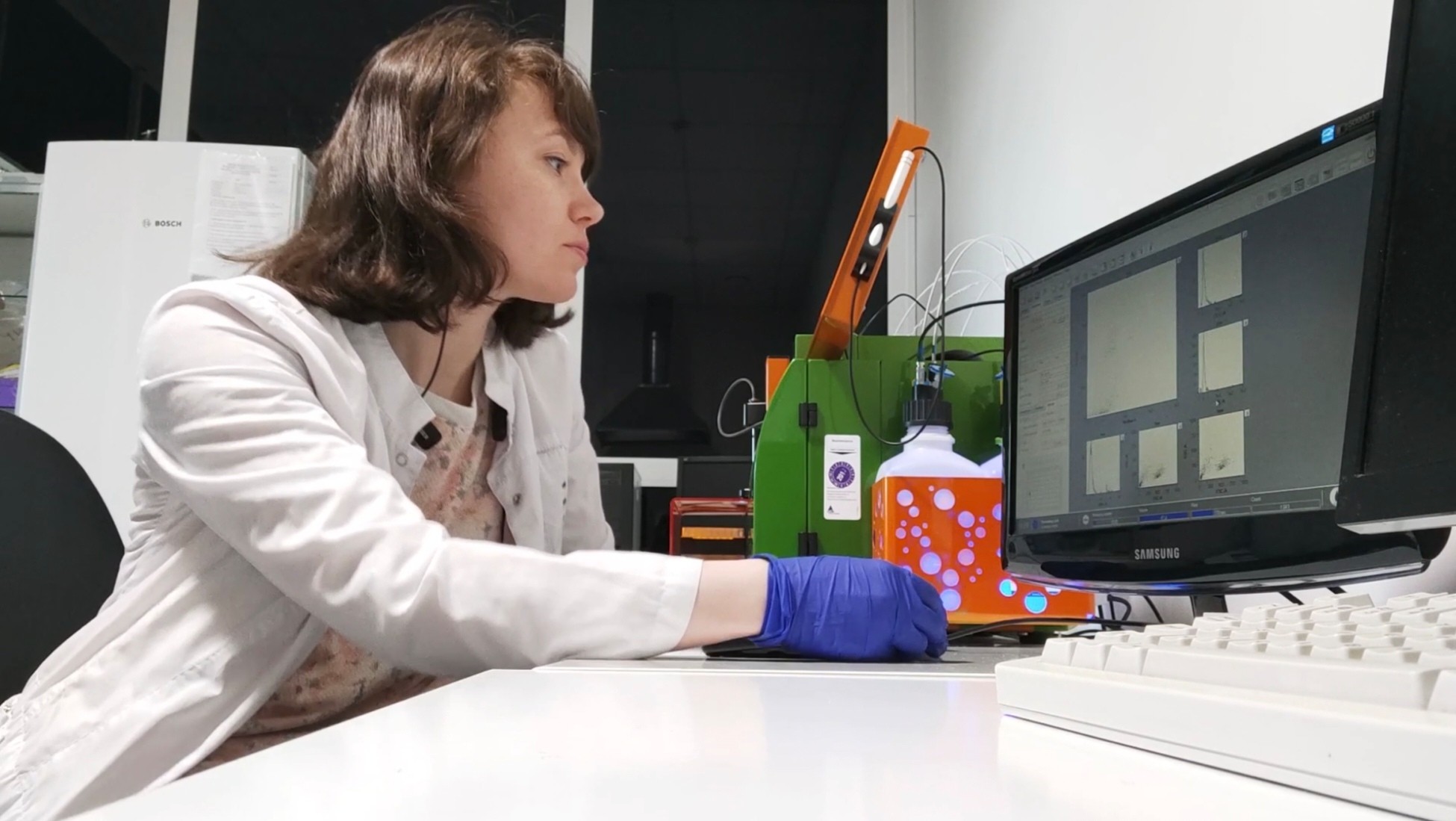
Experiments with human mesenchymal stem cells demonstrated high biocompatibility of the material: cells survived significantly better on coated surfaces than on uncoated titanium. An interesting finding emerged during the early stages — seven days after seeding the cells onto the material — coatings with higher nitrogen content appeared to have a calming effect on the cells, reducing the activity of certain genes responsible for the rapid transformation of stem cells into bone cells. At the same time, the bone‑forming potential of the cells was fully preserved. This suggests that the coating acts as a safety cushion for processes requiring longer observation.
| Vladimir Malaschenko, Candidate of Biological Sciences, Research Fellow at the IKBFU Centre for Immunology and Cell Biotechnology |
| The main goal of the study was to find the optimal ratio of synthesis components. The use of nitrogen‑enriched calcium phosphate coatings is a promising approach that could help create a healing microenvironment around implants. This, in turn, addresses the problem of medical device rejection by the body. |
The development of such materials represents an important step towards personalised healthcare solutions that could accelerate patient rehabilitation and minimise the risk of complications after complex orthopaedic surgeries.
| Vladimir Malaschenko, Candidate of Biological Sciences, Research Fellow at the IKBFU Centre for Immunology and Cell Biotechnology |
| In the future, we plan to conduct additional studies on stem cells at later stages — 10 to 28 days — as well as to investigate the solubility of the coatings and the rate and volume of nitric oxide release into surrounding tissues in a living organism. |
The research team also included specialists from Saint Petersburg State University.
Picture 1: Study author Olga Khaziachmatova evaluates cell viability by flow cytometry. Source: Vladimir Malaschenko / personal archive.

User profile for student
User profile for student
I give consent to the processing of the personal data provided, with Personal Data Processing Policy acquainted
Confirm consent